
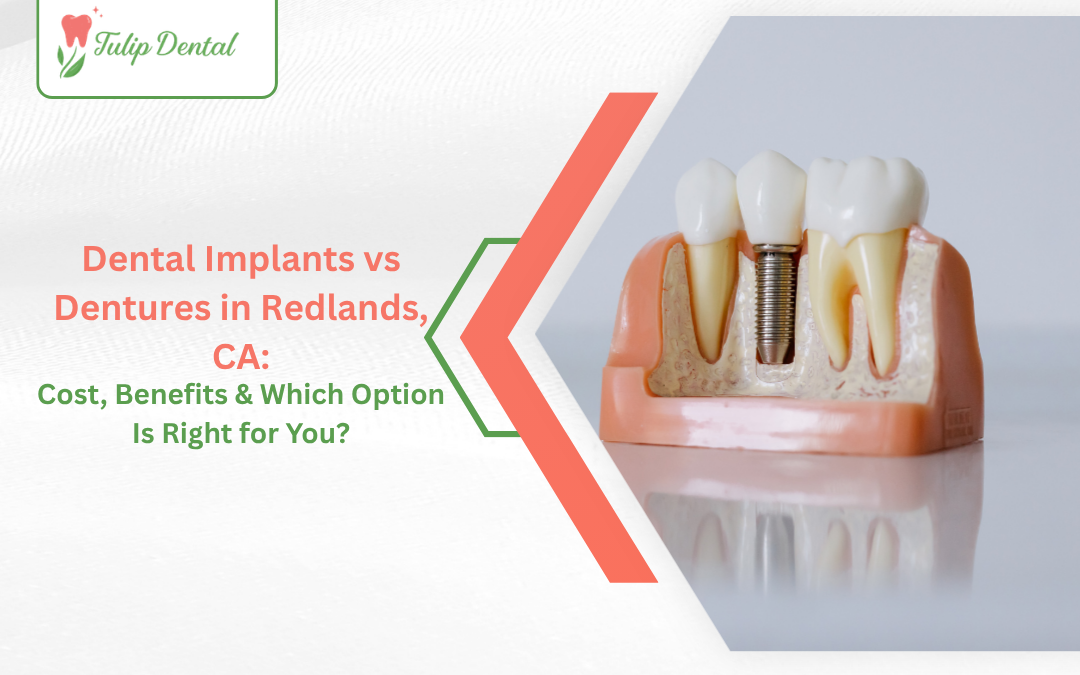
If you’re missing one or more teeth, the two most common tooth replacement options are dental implants and dentures. Dental implants are surgically placed titanium posts that anchor a permanent crown or bridge, while dentures are removable appliances that rest on your gums. The right choice depends on how many teeth you’re replacing, your jawbone health, your budget, and how you want your new teeth to feel and function day to day.
This guide breaks down how implants and dentures compare, what affects cost, and how to figure out which option fits your situation — so you can walk into a dental implant consultation in Redlands, CA with realistic expectations.
Dental Implants vs Dentures: What's the Difference?
Dental implants replace a missing tooth from the root up. A titanium post is placed in the jawbone, where it fuses with bone over a healing period, then a custom crown is attached on top. Because the implant is anchored in bone, it functions much like a natural tooth root — it doesn’t move, and it helps preserve the bone structure that would otherwise shrink after tooth loss.
Dentures are removable prosthetic teeth that sit on top of the gums. Traditional dentures rely on suction and the shape of your gums to stay in place, while implant-supported dentures (overdentures) are anchored to a small number of implants for added stability. Dentures can replace a few teeth (partial dentures) or a full arch (complete dentures), and they don’t require surgery to fit.
Both options restore your ability to chew and speak comfortably and can look natural the decision usually comes down to stability, long-term bone health, budget, and how many teeth need replacing.
Dental Implants vs Dentures at a Glance
| Factor | Dental Implants | Dentures |
|---|---|---|
| Stability | Fixed in the jawbone; doesn't shift while eating or speaking | Removable; traditional dentures can shift or require adhesive |
| Appearance | Designed to closely mimic natural teeth | Modern dentures look increasingly natural, but fit can change over time |
| Chewing/Function | Functions similarly to natural teeth | Can restore basic chewing, though force is often more limited than implants |
| Bone preservation | Helps preserve jawbone by stimulating it like a natural root | Does not prevent jawbone loss the way implants can |
| Maintenance | Brush and floss like natural teeth; routine dental visits | Daily removal and cleaning; periodic relining or adjustment |
| Longevity | Often lasts decades or longer with proper care | Typically needs replacing or relining every several years |
| Treatment process | Surgical placement plus a healing period before the final restoration | Non-surgical; impressions and fittings, with a shorter timeline |
| Cost considerations | Higher upfront investment, often lower long-term cost per year of use | Lower upfront cost, but may need periodic replacement over time |
Individual results depend on your oral health, bone density, and treatment plan, which is why a dentist’s evaluation is the best way to know how these factors apply to you.
Benefits of Dental Implants
For many patients dealing with missing teeth, implants offer several practical advantages:
- Stability — because implants integrate with the jawbone, they don’t slip or move during eating or speaking.
- Natural appearance and feel — a well-fitted implant crown is designed to blend in with surrounding teeth.
- Preserved chewing function — implants can support closer-to-normal biting force than removable dentures.
- Jawbone preservation — implants can help prevent the bone loss that often follows tooth loss, which over time can also help maintain facial structure.
- Long-term durability — with proper oral hygiene and regular checkups, implants can last many years, and often decades.
Implants aren't automatically the right fit for everyone. Candidacy depends on having adequate jawbone density (or being a candidate for bone grafting) and generally good oral health, which your dentist can assess. Learn more about the dental implant process in Redlands and what to expect.
Benefits of Dentures
Dentures remain a reliable, well-established option, especially for patients who aren’t ready for or interested in surgery. Advantages include:
- Lower upfront cost compared to implant-based treatment, making them accessible for patients working within a tighter budget.
- Non-surgical — dentures can be a good option for patients who prefer to avoid or aren’t candidates for surgical procedures.
- Faster turnaround in many cases, since there’s no bone-healing period required.
- Full or partial options — dentures can replace a single arch, both arches, or just a few missing teeth.
- Improved comfort with modern materials, which offer a more natural look and feel than older denture designs.
Dentures can also be combined with implants implant-supported overdentures offer more stability than traditional dentures while typically costing less than a full set of individual implants. This can be a practical middle-ground for patients missing most or all of their teeth in an arch.
Dental Implants vs Dentures: Cost in Redlands, CA
There’s no single price that applies to every patient, because the cost of both implants and dentures depends on your specific treatment needs. Factors that influence dental implant cost in Redlands, CA include:
- Number of teeth being replaced (a single implant vs. multiple implants vs. a full-arch solution)
- Whether bone grafting is needed to support the implant
- Whether extractions are required before placement
- The type of final restoration (single crown, bridge, or implant-supported denture)
- Materials and components used for the implant and restoration
For denture costs in Redlands, CA, pricing depends on:
- Whether you need a partial or complete denture
- Whether the denture is traditional or implant-supported
- The materials used and any custom fitting requirements
Because every treatment plan is different, the most accurate way to understand your costs is through an in-person evaluation. Tulip Dental also works with many major insurance providers and offers flexible financing and payment options, including in-house payment plans and third-party financing, to help make treatment more manageable.
Ready to get a clear picture of your options? Schedule a dental implant consultation and get treatment costs specific to your situation.
Which Option Is Right for You?
The best tooth replacement option depends on several individual factors, including:
- How many teeth you’re missing — a single missing tooth, several teeth, or a full arch each call for different solutions.
- Your jawbone health — sufficient bone density is generally needed to support implants, though bone grafting can sometimes make implants possible.
- Your overall oral health — certain conditions may affect candidacy for surgical treatment.
- Your budget and financing preferences — including whether you’d rather pay more upfront for a long-term solution or spread costs differently.
- Your desired stability and lifestyle — some patients prioritize a fixed, natural-feeling solution, while others prefer the flexibility of a removable option.
- Your long-term goals — including how you feel about bone preservation and long-term maintenance.
Because these factors interact differently for every patient, the most reliable way to determine which option fits you is a one-on-one evaluation with a qualified dentist who can review your oral health, take imaging as needed, and walk through your options in detail.
Why Consider Tulip Dental in Redlands, CA?
Tulip Dental is a family and cosmetic dental practice in Redlands offering comprehensive services, including dental implants , full-arch restorations (All-on-4 implants, implant-supported overdentures, and traditional dentures), and general restorative care — all in one office. The practice takes a patient-centered approach, taking time to explain treatment options and help patients make informed decisions about their care.
Tulip Dental accepts most major dental insurance plans and offers flexible financial and payment options , including in-house payment plans and third-party financing, to help make implant and denture treatment more accessible.
If you're weighing dental implants against dentures and want guidance specific to your smile, the team at Tulip Dental can walk you through your options during a consultation. Contact Tulip Dental or call (909) 488-0222 to get started.
Frequently Asked Questions
Are dental implants better than dentures?
Neither option is universally “better” implants generally offer more stability and help preserve jawbone, while dentures are non-surgical and typically cost less upfront. The right choice depends on your oral health, budget, and goals, which a dentist can help you evaluate.
Are dental implants more expensive than dentures?
Implants usually involve a higher upfront investment than dentures because of the surgical placement and materials involved. However, cost varies widely based on how many teeth are being replaced and the type of restoration needed, so a personalized quote is the only way to know your actual cost.
How long do dental implants last?
With proper oral hygiene and regular dental visits, implants can last many years and often decades. Individual results vary based on bone health, oral hygiene, and overall health.
How long do dentures last?
Dentures typically last around 5 years before they may need relining, adjustment, or replacement, though this varies based on wear, changes in your mouth over time, and how well they’re cared for.
Can anyone get dental implants?
Most healthy adults with adequate jawbone density are candidates for implants, and bone grafting can help some patients who don’t initially have enough bone. A dental evaluation is the best way to confirm candidacy.
Do dental implants look natural?
Yes implant crowns are custom designed to match the size, shape, and color of your surrounding teeth for a natural appearance.
How do I choose between implants and dentures?
The best way to choose is a professional evaluation that looks at the number of missing teeth, your bone health, budget, and lifestyle preferences. A dentist can walk you through the pros and cons based on your specific mouth.
What’s the main difference between dental implants and dentures?
Dental implants are surgically anchored in the jawbone and function as a permanent, fixed replacement, while dentures are removable appliances that rest on the gums. Implants generally offer more stability and help preserve jawbone, while dentures are non-surgical and typically involve a lower upfront cost.
Are dental implants worth the cost compared to dentures?
It depends on individual priorities. Implants often cost more upfront but can last decades with proper care and don’t typically need replacing like dentures do. Dentures cost less initially but may need relining or replacement over time. A dentist can help weigh long-term value against your budget.
Can you switch from dentures to dental implants later?
Many patients who start with dentures can transition to implants later, including implant-supported overdentures, as long as they have adequate jawbone density or are candidates for bone grafting. A dental evaluation can confirm eligibility.
Do dental implants require a lot of maintenance?
Dental implants are cared for like natural teeth regular brushing, flossing, and dental checkups. Unlike dentures, they don’t require nightly removal or soaking, though good oral hygiene is still essential for long-term success.
How do I know if I need a full denture or just a partial one?
The choice depends on how many teeth are missing. A partial denture replaces a few missing teeth while leaving healthy natural teeth in place, while a complete (full) denture replaces all teeth in an arch. A dentist can evaluate your mouth to determine which applies to you.